From Dashboards to Conversations: The Future of Business Intelligence
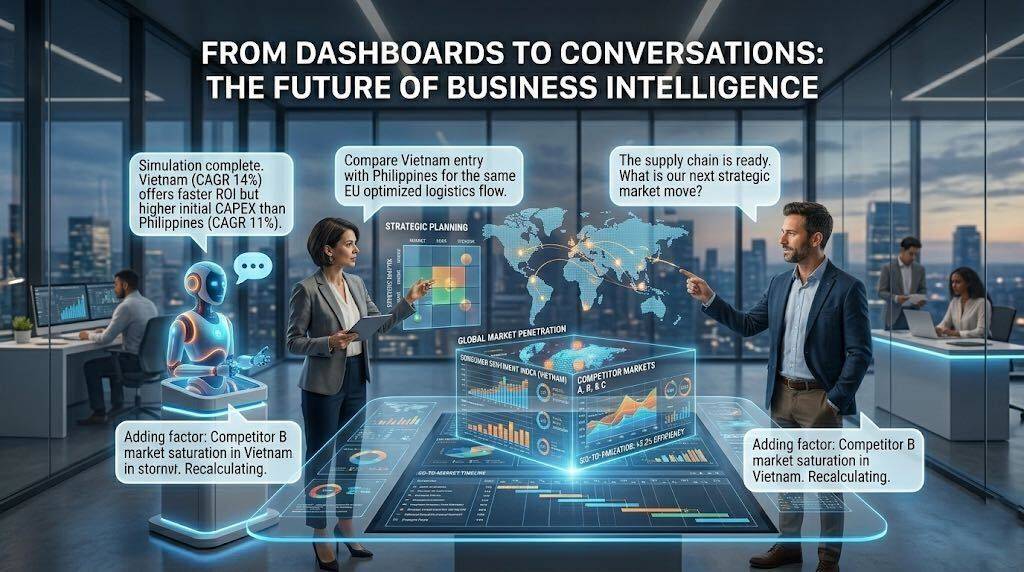
For decades, dashboards have been the primary way businesses interact with data. Charts, filters, exports, pivot tables, KPIs, drill-downs — modern Business Intelligence platforms have transformed how organizations measure performance and monitor operations. But despite all the progress in visualization and reporting, one major challenge still exists:
Most business data remains difficult to truly interact with.
Executives still depend on analysts to build reports. Teams still spend hours navigating dashboards to answer relatively simple questions. Insights are often delayed by fragmented systems, manual analysis, and the complexity of modern data environments.
At the same time, the volume of data inside organizations continues to grow exponentially. The problem is no longer access to data. The problem is accessibility of insights.
We are entering a new phase in the evolution of Business Intelligence — one where users no longer need to navigate complex interfaces to understand their data.
Instead of asking:
- “Which dashboard contains this metric?”
- “Can someone generate this report?”
- “How do I filter this segment?”
Users are beginning to ask questions naturally:
- “Why did customer satisfaction drop last quarter?”
- “Which regions showed the highest growth after the campaign?”
- “Summarize the top concerns mentioned in customer feedback.”
- “Compare this month’s performance against last year.”
This shift changes the relationship between people and data. The interface is no longer the dashboard. The interface becomes conversation.
Dashboards remain incredibly valuable for monitoring and operational visibility. But they also come with limitations:
Static Views of Dynamic Questions
Dashboards are designed around predefined metrics and layouts. Business questions, however, are rarely predefined. New questions constantly emerge:
- unexpected trends
- operational anomalies
- customer behavior changes
- market shifts
- executive follow-ups
Traditional reporting systems struggle to adapt quickly enough.
Dashboard Fatigue
Organizations today often operate dozens — sometimes hundreds — of dashboards across different departments and platforms. Users frequently face:
- information overload
- inconsistent metrics
- excessive filtering
- steep learning curves
- dependency on analysts
In many cases, the data exists — but the insight remains buried.
The Gap Between Data and Decision-Making
Business users do not always think in SQL queries, filters, or visualization structures. They think in business questions. Modern analytics systems need to bridge that gap more naturally.
AI-powered conversational analytics introduces a fundamentally different interaction model. Instead of navigating through layers of dashboards, users can:
- ask questions in plain language
- receive contextual summaries
- explore trends interactively
- generate visualizations dynamically
- drill deeper through follow-up questions
This dramatically reduces the friction between curiosity and insight. The result is faster decision-making, broader accessibility, and more agile exploration of data.
The first generation of AI data tools focused heavily on retrieval — allowing users to “chat with PDFs” or search through documents conversationally. But enterprise analytics requires more than retrieval.
Business intelligence involves:
- structured and unstructured data
- analytical reasoning
- comparisons and trend analysis
- statistical interpretation
- explainability and traceability
- contextual understanding
This is where the concept of an AI Insight Engine begins to emerge. An insight engine is not simply a chatbot sitting on top of documents. It is a system designed to help users explore, analyze, interpret, and interact with business data more intelligently.
The future of analytics is unlikely to replace dashboards entirely. Instead, dashboards and conversational AI will increasingly work together.
Dashboards will continue to provide:
- monitoring
- operational visibility
- executive KPI tracking
Conversational interfaces will provide:
- exploration
- interpretation
- summarization
- deeper questioning
- faster access to insights
Together, they create a more natural and intelligent analytical experience.
At insy8.ai, we believe the future of analytics lies in making data interaction more human, conversational, and insight-driven. insy8.ai is designed as an AI Insight Engine that helps teams interact with research and business data naturally — asking questions, generating summaries, surfacing insights, and exploring information conversationally.
Rather than replacing existing systems, the goal is to add a new intelligence layer on top of organizational data — helping businesses move from static reporting toward dynamic understanding.
"Because the future of Business Intelligence is not just about seeing data. It is about having conversations with it."